


How often should a Safety Data Sheet (SDS) be updated?
“How often do I need to update my SDS?” It is one of the questions we are asked most frequently. The honest answer: there is no fixed time limit. European legislation does not prescribe an expiry date for a Safety Data Sheet. But that does not mean you can sit back and relax. There are three clearly defined situations in which updating is legally required, plus a whole range of practical circumstances that make a revision necessary.
In this article we explain what the REACH Regulation actually requires, which situations lead to an SDS revision, and how you as a supplier or manufacturer can ensure your Safety Data Sheets remain up to date.
| Trigger | Legal basis |
| New information on hazards or risk management measures | Art. 31(9)(a) REACH |
| Authorisation granted or refused | Art. 31(9)(b) REACH |
| Restriction imposed | Art. 31(9)(c) REACH |
What does REACH say about updating an SDS?
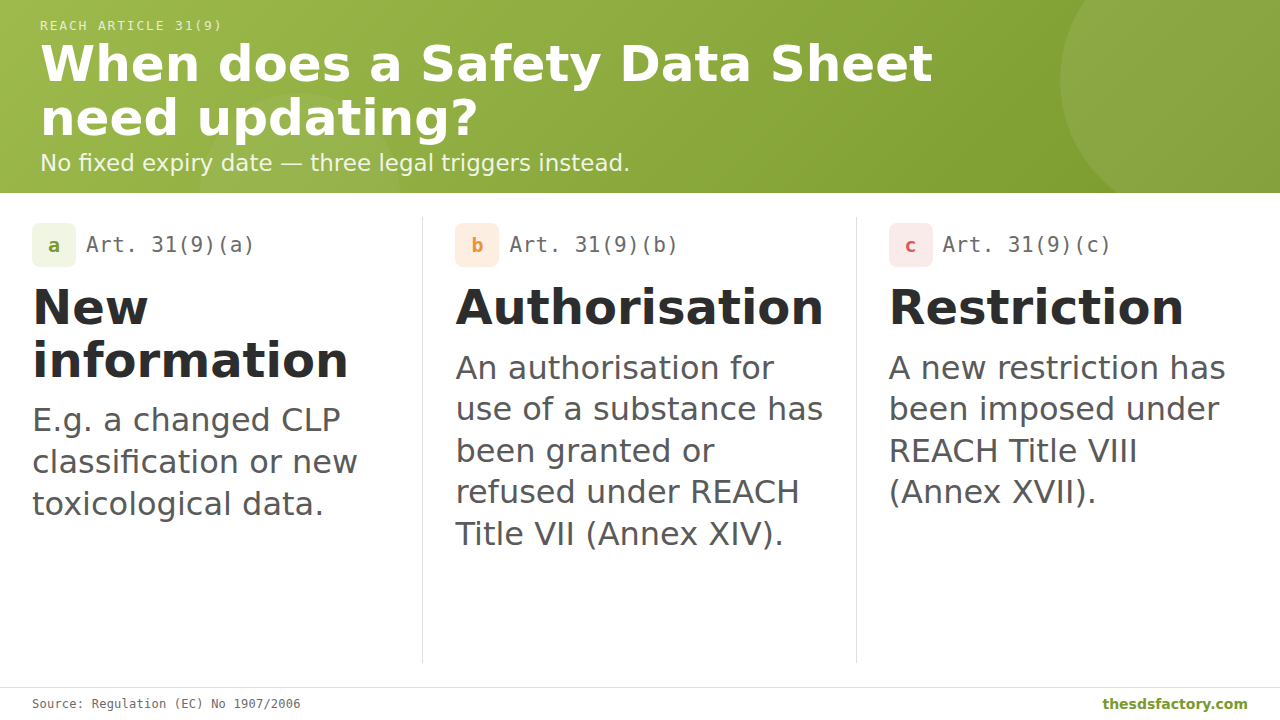
The legal basis is found in Article 31(9) of REACH (Regulation (EC) No 1907/2006). This article requires suppliers to update their SDS “without delay” in three situations:
(a) as soon as new information that may affect the risk management measures, or new information on hazards, becomes available
(b) once an authorisation has been granted or refused (Annex XIV of REACH)
(c) once a restriction has been imposed (Annex XVII of REACH)
The remainder of paragraph 9 stipulates that the new, dated version, identified as “Revision: (date)”, must be provided free of charge in paper or electronic form to all former recipients to whom the substance or mixture has been supplied in the preceding twelve months.
These are the only three situations in which updating is legally mandatory. The wording “without delay” leaves no room for postponement: as soon as one of these situations arises, you must take action. This obligation applies to every actor in the supply chain who supplies a substance or mixture, from manufacturer and importer to downstream user and distributor.
There is no legal expiry date
A common misconception: many companies assume that an SDS automatically expires after a certain period (two, three or five years). This is not correct for the EU. The REACH Regulation does not prescribe a fixed validity period for a Safety Data Sheet.
This contrasts with some other jurisdictions, where a fixed revision period does apply (often three to five years). But the absence of such a period in the EU does not make updating any less urgent. It shifts the responsibility to you as a supplier to actively monitor whether there are any changes that necessitate a revision.
Which situations lead to a revision in practice?
Article 31(9) lists three legal triggers, but in day-to-day practice there is considerably more to it. Below is an overview of the most common situations.
Change in hazard classification (CLP)
Through an ATP (Adaptation to Technical Progress) of the CLP Regulation, new or amended harmonised classifications are published on a regular basis. If this changes the classification of a substance or mixture, the SDS must be updated. This falls under point (a) of Article 31(9) of REACH: new information on hazards. In the case of a harmonised classification, the substance also receives an index number from Annex VI of the CLP Regulation, which must be stated in section 3 of the SDS. For mixtures, this applies both to the classification of the final product and to the classification of any ingredient listed in section 3 of the SDS.
ATPs follow each other in rapid succession. The most recent is the 23rd ATP (Commission Delegated Regulation (EU) 2025/1222), published on 20 June 2025 and mandatory from 1 February 2027. Less than two years earlier, the 22nd ATP (Commission Delegated Regulation (EU) 2024/197) became mandatory from 1 December 2025. Each new ATP may have consequences for your classifications and therefore for your Safety Data Sheets.
New hazard classes under the CLP Regulation
A particularly topical trigger: through Commission Delegated Regulation (EU) 2023/707, four new hazard classes have been added to the CLP Regulation:
- endocrine disruption for human health (ED HH);
- endocrine disruption for the environment (ED ENV);
- persistent, bioaccumulative and toxic, or very persistent and very bioaccumulative (PBT/vPvB);
- persistent, mobile and toxic, or very persistent and very mobile (PMT/vPvM).
The deadlines for implementation run from 1 May 2025 (new substances) to 1 May 2028 (existing mixtures). Does a substance or component in your mixture fall under one of these new classes? Then sections 2, 11 and 12 of the SDS in particular are affected and you must update the relevant information before the deadline.
Inclusion on the Candidate List (SVHC)
If a substance is included on the ECHA Candidate List as a Substance of Very High Concern (SVHC), this may have consequences for the SDSs of mixtures containing that substance. If an SVHC substance is present in a mixture above the threshold of 0.1% (w/w), information about this must be included in the relevant sections of the SDS.
The Candidate List is typically updated twice a year (in January and June/July). The list currently contains more than 250 entries, including group entries that cover multiple substances.
Changed workplace exposure limits
If new or more stringent workplace exposure limits (Occupational Exposure Limits, OELs) are established, whether at EU level or nationally, this is new information that must be incorporated in section 8 of the SDS. Recent examples at EU level: Directive (EU) 2022/431, the fourth amendment to the Carcinogens and Mutagens Directive (CMD4), extended the scope to include reprotoxic substances, and Directive (EU) 2024/869 established new limit values for lead and diisocyanates (transposition deadline for Member States: 9 April 2026).
Change in the Annex II format
The format and content of an SDS are prescribed in Annex II of REACH. This annex is periodically revised. The most recent substantive revision was Regulation (EU) 2020/878, which became applicable from 1 January 2021. The transition period for existing SDSs expired on 31 December 2022. Since that date, all Safety Data Sheets on the EU market must comply with the current format, even if nothing has changed in the substance or mixture itself.
New toxicological or ecotoxicological data
If new studies, test results or scientific insights become available on the substance or mixture, for example from REACH registration dossiers, peer-reviewed publications or ECHA evaluations, this may lead to a reassessment of the hazardous properties and of the hazard classification. In that case, an update is required.
Changed composition of a mixture
If the composition of a mixture changes, for instance a different raw material or a changed concentration of a hazardous component, you must assess whether the classification and the SDS are still correct. A change above certain thresholds (see Article 15 of the CLP Regulation) will in most cases lead to a new or revised SDS.
Authorisation or restriction under REACH
The other two legal grounds from Article 31(9) occur less frequently in practice, but are no less important. If an authorisation is granted or refused for a substance (Annex XIV of REACH), the SDS must be updated with the conditions of the authorisation or the consequences of the refusal. The same applies when a restriction is imposed (Annex XVII of REACH): the new conditions of use or prohibitions must be incorporated into the SDS.
What needs to be changed during a revision?
Section 16 of Annex II of REACH prescribes that a revised SDS must clearly indicate which changes have been made compared to the previous version, together with an explanation of the changes where applicable.
In addition, a revised SDS must:
- state the revision date, typically in section 16 and/or on the first page as “Revision: (date)”;
- carry a version number, so that it is traceable which version is current;
- be distributed to all recipients who have received the substance or mixture in the preceding 12 months;
- be provided free of charge, in paper or electronic form;
- contain the registration number if the revision takes place after registration in a REACH dossier.
The ECHA Guidance on the Compilation of Safety Data Sheets provides detailed guidelines on how to document revisions in practice.
No expiry date, yet regular reviews?
Although the EU does not prescribe a fixed revision period, it is good practice to review your Safety Data Sheets periodically, even if there is no immediate legal trigger. Exposure limits are regularly revised, formulation changes at your suppliers’ end can have a knock-on effect on your own SDSs, and legislative changes such as the new hazard classes (Commission Delegated Regulation (EU) 2023/707) require proactive planning. Without active monitoring, you risk overlooking a change.
Frequently asked questions (FAQ)
Does an SDS have a legal expiry date in the EU?
No. The REACH Regulation does not prescribe a validity period. An SDS is valid for as long as its content is up to date and complies with the applicable legislation. Note: some non-EU jurisdictions (China, Japan, Taiwan, Australia, Singapore) do have a fixed revision period.
What does “without delay” mean in Article 31(9)?
The REACH Regulation does not further define “without delay” in terms of a specific number of days or weeks. The expectation is that you as a supplier act as quickly as reasonably possible after new information becomes available. Waiting until a customer asks for it is not sufficient.
Do I need to update my SDS if the CLP classification of a component changes?
That depends on the effect on the SDS. If the classification of a substance or component changes in such a way that it affects the classification of the mixture, the content of section 3, or the risk management measures, this is new information within the meaning of Article 31(9)(a) and the SDS must be revised. A classification change of a component that does not need to be listed in section 3 and has no effect on the mixture classification does not necessarily require a revision.
To whom must I provide the updated SDS?
To all recipients who have received the substance or mixture from you in the preceding 12 months, free of charge, in paper or electronic form. This is an active obligation: you do not wait for a recipient’s request.
What changes do the new CLP hazard classes mean for my SDSs?
Commission Delegated Regulation (EU) 2023/707 introduces four new hazard classes: endocrine disruption for human health (ED HH), endocrine disruption for the environment (ED ENV), PBT/vPvB and PMT/vPvM. Is a substance or component in your mixture classified under one of these? Then sections 2, 11 and 12 of the SDS in particular are affected. The deadlines run from 1 May 2025 (new substances) to 1 May 2028 (existing mixtures).
Is an SDS that complies with the old format (Regulation 2015/830) still valid?
No, not anymore. The transition period for the new format under Regulation (EU) 2020/878 expired on 31 December 2022. All SDSs supplied on the EU market must now comply with the current Annex II of REACH.
How do I correctly document a revision?
Section 16 of Annex II of REACH requires a clear indication of what has changed compared to the previous version, with an explanation where applicable. Point 0.2.5 of Annex II of REACH additionally prescribes that a revised SDS must bear the notation “Revision: (date)” on the first page, plus one or more indications of which version is being replaced, such as a version number, revision number or replacement date. The ECHA Guidance on SDS Compilation (v4.0) recommends an incremental system: version 1.0 for the first issue, version 1.1 or 1.2 for changes that do not require mandatory distribution, and version 2.0 for changes that do fall under Article 31(9).
Need help updating your Safety Data Sheets?
Updating Safety Data Sheets is not a one-off task, it is an ongoing process that requires active monitoring of legislation, classifications and exposure limits. No time or capacity to keep up with that yourself? We are happy to help. Contact us at info@thesdsfactory.com or call +31 85 009 2200, and we will review whether your SDSs are still up to date.