


What is a Safety Data Sheet (SDS)?
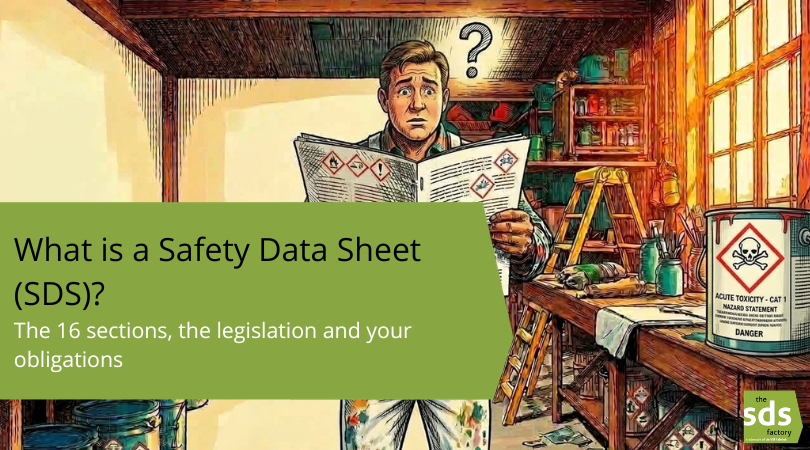
A Safety Data Sheet (SDS) is a document that describes the hazards of a chemical substance or mixture and how to handle it safely. It forms the backbone of the information chain in the chemical industry: from manufacturer to professional end user.
Do you work with hazardous substances or mixtures? Then you almost certainly deal with Safety Data Sheets. In this article, we explain what an SDS is, when you are required to provide one, what the 16 sections contain, and what the key rules are under REACH and CLP.
What exactly is a Safety Data Sheet?
A Safety Data Sheet is a standardised document of 16 sections that provides information on:
- the hazardous properties of a substance or mixture
- the risks to human health and the environment
- the measures for safe use, storage, and transport
- first aid measures in case of exposure
- the applicable legislation and regulations
The legal basis lies in the EU REACH Regulation (Regulation (EC) No 1907/2006), specifically in Article 31. Its content and format are laid down in Annex II of REACH, most recently substantially amended by Regulation (EU) 2020/878.
The SDS is not a voluntary document. It is a legally binding document through which suppliers demonstrate compliance with their information obligation. At the same time, it is the recipient's primary source for managing risks in the workplace.
SDS, MSDS: what is the difference?
You may come across different abbreviations, but they all refer to the same document:
- SDS = Safety Data Sheet (the current internationally used term)
- MSDS = Material Safety Data Sheet (the old term, used before the GHS system)
The term MSDS has been formally outdated since the introduction of the Globally Harmonized System (GHS) and the European CLP Regulation. In practice, you still encounter the term regularly, but the correct designation is SDS. In Dutch, the same document is called a veiligheidsinformatieblad (ViB), and in Belgium it is commonly referred to as a veiligheidsfiche.
When is a Safety Data Sheet required?
Not every product requires an SDS. Article 31 of REACH determines precisely when you must provide one. There are three situations in which an SDS is mandatory and one in which it must be provided on request.
Mandatory provision (Art. 31(1))
You are required to provide an SDS when:
(a) you supply a substance or mixture that meets the criteria for classification as hazardous under the CLP Regulation (Regulation (EC) No 1272/2008)
(b) you supply a substance that is identified as PBT (persistent, bioaccumulative and toxic) or vPvB (very persistent and very bioaccumulative) according to the criteria of Annex XIII of REACH
(c) you supply a substance that is included on the Candidate List of Substances of Very High Concern (SVHCs) for reasons other than (a) or (b)
Note: PMT/vPvM and the SDS obligation
Art. 31(1)(b) specifically refers to PBT and vPvB according to the criteria of Annex XIII of REACH. The newer PMT and vPvM criteria are hazard classes under the CLP Regulation, added by Commission Delegated Regulation (EU) 2023/707. A substance classified as PMT or vPvM is therefore hazardous under CLP and falls under the SDS obligation via paragraph 1(a). However, PMT/vPvM is not an independent criterion for inclusion on the Candidate List (Art. 57 REACH). ECHA can, however, identify such substances as SVHCs on a case-by-case basis under Art. 57(f), the "equivalent level of concern" criterion. Read more about these new hazard classes in our article CLP Regulation: New hazard classes ED, PBT, vPvB, PMT, vPvM.
Provision on request (Art. 31(3))
For non-classified mixtures that nevertheless contain certain hazardous substances, you must provide an SDS if the recipient requests one. This applies when the mixture contains the following substances:
- substances with health or environmental hazards at a concentration of ≥ 1% by weight (non-gaseous) or ≥ 0.2% by volume (gaseous)
- substances classified as carcinogenic category 2, toxic for reproduction 1A/1B/2, skin sensitiser category 1, respiratory sensitiser category 1, with effects on or via lactation, PBT or vPvB according to Annex XIII, or included on the Candidate List (Art. 59(1)), at a concentration of ≥ 0.1% by weight
- substances for which a European occupational exposure limit exists
Exemption for consumer products (Art. 31(4))
Do you supply a hazardous product directly to consumers? Then you do not need to provide an SDS, provided you supply sufficient information to protect health and the environment (such as the CLP label). Note: this exemption applies only to direct sales to the consumer. If you supply the same product to a professional recipient or distributor, the regular SDS obligation under Art. 31(1) applies.
Which products are exempt?
Certain product categories in their finished form, intended for the end user, fall outside the REACH obligation for SDSs (Art. 2(6) REACH). These include:
- medicinal products (Directive 2001/83/EC)
- cosmetic products: REACH refers to Directive 76/768/EEC, now replaced by the Cosmetics Regulation (EC) No 1223/2009)
- medical devices that are invasive or in direct physical contact with the body (Regulation (EU) 2017/745)
- food and animal feed (Regulation (EC) No 178/2002)
- articles within the meaning of REACH, unless they release hazardous substances under normal or reasonably foreseeable conditions of use
Note: the exemption applies to the finished product in its final form for the end user in those categories. The raw materials and intermediates used to manufacture them are fully subject to the SDS obligation.
The 16 sections of a Safety Data Sheet
Annex II of REACH prescribes a fixed structure of 16 sections. The order is mandatory and no section may be omitted. If no data are available for a particular section, this must be explicitly stated along with the reason why.
| Section | Title | What does it contain? |
|---|---|---|
| 1 | Identification of the substance/mixture and of the company/undertaking | Product identifier, relevant uses, supplier details, emergency number |
| 2 | Hazards identification | CLP classification, labelling elements (pictograms, signal word, H and P statements), other hazards (PBT/vPvB status, endocrine disrupting properties) |
| 3 | Composition/information on ingredients | For substances: identity and impurities. For mixtures: hazardous ingredients with concentration (ranges) |
| 4 | First-aid measures | Measures per route of exposure (inhalation, skin contact, eye contact, ingestion), acute and delayed symptoms |
| 5 | Firefighting measures | Suitable extinguishing media, special hazards, advice for firefighters |
| 6 | Accidental release measures | Personal precautions, environmental precautions, containment and clean-up |
| 7 | Handling and storage | Precautions for safe handling, conditions for safe storage, incompatibilities |
| 8 | Exposure controls/personal protection | Exposure limits (OELs), DNELs/PNECs where applicable, engineering controls, PPE specifications |
| 9 | Physical and chemical properties | Appearance, pH, boiling point, flash point, vapour pressure, density, solubility, etc. (18 mandatory parameters in section 9.1) |
| 10 | Stability and reactivity | Reactivity, chemical stability, hazardous decomposition products, incompatible materials |
| 11 | Toxicological information | Acute and chronic effects per route of exposure, target organ toxicity |
| 12 | Ecological information | Aquatic toxicity, persistence, bioaccumulation, PBT/vPvB assessment |
| 13 | Disposal considerations | Waste treatment methods, packaging waste |
| 14 | Transport information | UN number, proper shipping name, hazard class, packing group |
| 15 | Regulatory information | Specific safety, health and environmental legislation for the substance or mixture |
| 16 | Other information | Date of last revision, changes compared to previous version, abbreviations used |
What changed in the SDS with Regulation (EU) 2020/878?
Regulation (EU) 2020/878 is the most recent substantial amendment to Annex II. The regulation has applied since 1 January 2021 for new SDSs. Existing SDSs had to be updated by 31 December 2022 at the latest. The key changes:
- Nanoforms: where a substance contains nanoforms, sections 1, 3, and 9 now require specific information (particle size distribution, shape, coatings).
- Endocrine disrupting properties: sections 2, 11, and 12 must now state whether a substance has endocrine disrupting properties.
- Section 9 restructuring: the layout of the physical and chemical properties has been completely revised. Section 9.1 now contains 18 mandatory parameters, from physical state and melting point to explosive limits and particle characteristics. Section 9.2 has been added for additional safety data such as corrosion rate for metals.
- Sensitising substances: lowered thresholds for the reporting of skin and respiratory sensitising substances in section 3.
- UFI: alignment with the Poison Centre Notification (PCN) obligation, including reference to the Unique Formula Identifier.
More details on these changes can be found in our earlier article The SDS Flash: changes to Annex II (Regulation EU 2020/878).
Extended Safety Data Sheet (eSDS): when is it required?
In addition to the standard SDS, there is the extended Safety Data Sheet, also known as the eSDS. This is an SDS with exposure scenarios attached as an annex. An eSDS is required for substances (not for mixtures) that:
- are registered under REACH
- are manufactured or imported in quantities of 10 tonnes or more per year per registrant
- are classified as hazardous or meet the PBT/vPvB criteria
The exposure scenarios describe the safe conditions of use and the risk management measures (RMMs) for each identified use. They include, among other things, derived no-effect levels (DNELs) and predicted no-effect concentrations (PNECs).
If you formulate your own mixtures, you do not need to prepare an eSDS for your mixture. However, you must incorporate the relevant information from the exposure scenarios of your raw materials into the SDS for your mixture, particularly in section 8.
In what language must an SDS be prepared?
Article 31(5) of REACH is clear: the SDS must be prepared in an official language of the Member State where the substance or mixture is placed on the market, unless that Member State provides otherwise.
In practice, this means:
- Supplying to Germany? Then an SDS in German.
- Supplying to France? Then an SDS in French.
- Supplying to Belgium? Depending on the language region, in Dutch, French, and/or German.
- Supplying to multiple EU countries? Then you need a version in the correct language for each country.
It is not just about translation. Each language-specific version must also include the national occupational exposure limits (section 8) and national legislation (section 15) applicable in that specific country. Translating an SDS is therefore not simply a matter of language: the content must also be adapted per country.
How long must you retain an SDS?
Article 36(1) of REACH requires manufacturers, importers, downstream users, and distributors to retain all information needed for preparing the SDS, plus the SDS itself, for a minimum of 10 years after the last time you manufactured, imported, supplied, or used the substance or mixture.
This also applies when you discontinue a product. As long as the 10-year retention period has not expired, you must keep the SDS available.
An SDS management platform such as Product Safety Cloud helps you manage your SDSs centrally and always have the correct version available.
Who is responsible for the SDS?
The supplier who places the substance or mixture on the market is responsible for preparing and providing the SDS. In practice, this can be:
- the manufacturer of the substance
- the importer who brings the substance or mixture into the EU
- the downstream user who formulates a mixture and places it on the market
- the distributor (who must pass on the SDS, but does not necessarily prepare it)
Important: even if you outsource the preparation of SDSs to an external party, you as the supplier remain legally responsible for the accuracy and completeness of the document.
How must an SDS be provided?
The SDS must be provided free of charge, on paper or electronically, no later than the date of the first delivery (Art. 31(8) REACH). Active provision is the key term: simply providing a link to a website where the recipient must search for and download the SDS themselves is not sufficient.
When updating the SDS (Art. 31(9) REACH), you must provide the new, dated version as soon as possible to all recipients to whom you supplied the substance or mixture in the preceding 12 months. The 12 months thus refer to the period during which you supplied, not a timeframe within which you may delay provision.
When must you update an SDS?
An SDS is not a static document. Article 31(9) of REACH requires you to update the SDS without delay when:
- new information becomes available on the hazards of the substance or mixture
- new information becomes available that may affect the risk management measures
- an authorisation has been granted or refused under REACH
- a restriction has been imposed under REACH
In addition, an update is required when the CLP classification of a substance changes (for example, due to a new ATP (Adaptation to Technical Progress)), or when national occupational exposure limits change.
Frequently asked questions about Safety Data Sheets
Is an SDS the same as a product data sheet?
No. A product data sheet (also known as a technical data sheet or TDS) describes the technical properties and applications of a product. It is a commercial document.
A Safety Data Sheet is a legally required document about the hazards and safe use of a substance or mixture.
The two complement each other, but the SDS is the only document with a legal obligation.
Does every chemical product need an SDS?
No. Only substances and mixtures that meet the criteria of Article 31 REACH (classified as hazardous, PBT/vPvB, or on the SVHC Candidate List) are mandatory. Non-hazardous mixtures containing certain hazardous ingredients above the threshold values require an SDS on request. Products such as cosmetics, medicinal products, and food fall outside REACH.
May I forward my supplier's SDS unchanged?
Only if you supply the substance unaltered. If you formulate a mixture using that substance as a raw material, you must prepare your own SDS for your mixture, based on the classification of the mixture as a whole. The SDSs of your raw materials are an important source of information for this purpose, but you cannot simply copy them.
What is the difference between an SDS and a label?
The CLP label is physically affixed to the packaging and provides the essential hazard information at a glance: pictograms, signal word, H statements, and P statements. As a comprehensive background document of 16 sections, the SDS gives the professional user all the details for safe use, storage, transport, and emergency situations. The label is derived from the information in the SDS, not the other way around.
How often must an SDS be revised?
There is no fixed revision interval. The law states: update without delay as soon as new relevant information becomes available. In practice, it is advisable to review SDSs periodically, for example every 24 months, to check whether there have been changes in the legislation (such as a new ATP), in occupational exposure limits, or in the hazard classification of ingredients.
Does the SDS obligation apply outside the EU?
The REACH obligation applies within the EU and the EEA. However, virtually every country in the world has its own variant of the GHS system with comparable requirements for Safety Data Sheets. The 16-section structure is largely the same worldwide. What differs are the classification rules, the exposure limits, and the local legislation. An SDS that complies with REACH does not automatically comply with the requirements in, for example, the US (OSHA HCS), China (GB/T 16483), or South Korea (K-REACH).
May an SDS be provided digitally?
Yes. Article 31(8) REACH permits both paper and electronic provision. The condition is that you actively provide the SDS, for example by e-mail as an attachment. Simply providing a link to a website where the recipient must search for and download it themselves is not sufficient according to the ECHA Guidance.
In summary
A Safety Data Sheet is the legally required document that describes the hazards of a chemical substance or mixture and provides instructions for safe use. It is regulated in Article 31 and Annex II of REACH, must follow the fixed structure of 16 sections, and must be prepared in the language of the country where you supply. As a supplier, you are legally responsible for its accuracy, even if you outsource its preparation.
Questions about your Safety Data Sheets? Or wondering whether your current SDSs still meet the latest requirements? Contact us at info@thesdsfactory.com or +31 85 009 2200. We are happy to help.