


CLP label changes: what the omnibus means for your label
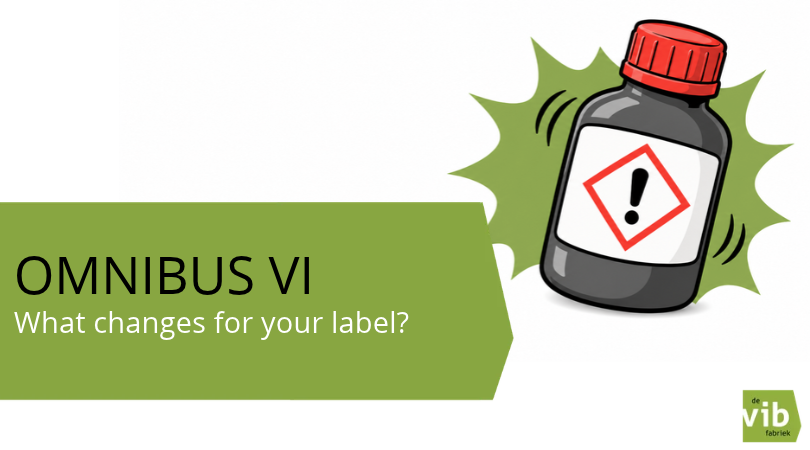
On 19 November 2026 the Council of the EU gave its final approval to the Omnibus VI package. That means the revision of the revision is done! Omnibus VI, the Commission's simplification package, has led, among other things, to changes to the CLP update published in November 2024 and with it to amendments to the CLP Regulation, Regulation (EC) No 1272/2008. The aim of the omnibus package is less red tape for companies, while protecting health and the environment. For your CLP label, the result is a mix of new obligations, relaxations and a new timeline.
Here is what changes and when you need to have it in place.
Where does the omnibus stand?
As always, a regulation, or in this case an amendment to one, only enters into force on the twentieth day after publication in the Official Journal of the EU. On 19 November the Council approved the text (PE-CONS 48/26). You can read more in the Council press release. Publication in the Official Journal is expected before the end of 2026. That means the revision of the revision becomes law early in 2027, which ends a long period of uncertainty for industry. Until then, the current rules apply.
Digital contact details and a phone number on your label
Besides your name and address, your label will soon have to show digital contact details. The phone number, which used to be part of that list, gets its own point and is only needed when it is not directly available through the supplier's digital contact details.
What are digital contact details?
What falls under the definition of a "digital contact", the term the regulation uses? According to the amended text (Article 2, point 42), it is any online communication channel that is current and free of charge to access, such as an email address. You cannot force anyone to register or to download an app from your company, and the channel may not ask for personal data.
What does not count? According to recital 4 of the amending regulation, automatic replies to questions, chatbots, fax numbers and phone lines with automated answering fall outside the definition.
You can give the phone number in an automatic reply to your email address, or on the web page your contact details point to. You can also put it on a digital-only label. With several suppliers on the label, the name, address and digital contact details of the other suppliers can go on the digital label, as long as the EU supplier (Article 4(11)) is on the physical label.
A practical example: your label shows info@yourcompany.com. Someone emails that address and immediately gets an automatic reply with your phone number. That is allowed, because your number is then directly available through your digital contact details. A chatbot or a fax number on your label, on the other hand, is not a digital contact.
Legibility and font size
The whole industry has been waiting for this: what happens to the strict rules for the layout of the CLP label? This is what Regulation (EU) 2024/2865, the original revision of CLP, would have required from 1 January 2028:
- black text on a white background;
- line spacing of at least 120% of the font size;
- one sans-serif, easy-to-read font;
- letter spacing that keeps the font easy to read;
- a minimum x-height that increases with pack size: 1.2 mm up to and including 0.5 litres, 1.4 mm up to and including 3 litres, 1.8 mm up to and including 50 litres and 2.0 mm above that.
The omnibus replaces these fixed values with criteria. That relaxes the hard requirements, but it also leaves room for interpretation.
The text on your label has to be legible. CLP already says so, but the new text spells it out further (Article 31(3) and Annex I, point 1.2.1.5). At a minimum, your label needs:
- a colour that contrasts with the background;
- one sans-serif font that is easy to read;
- letter and line spacing that keep lines from overlapping;
- a font size that depends on the user of your product, and that is suitable and easy to read:
- Industrial/professional: no fixed minimum font size.
- Consumers (general public): a fixed minimum x-height of 1.2 mm, or 0.9 mm for packs of up to and including 125 ml (points 1.2.1.5.3 and 1.2.1.5.4). The x-height is the height of a lowercase letter without ascender or descender, like the letter x.
The text does not put "suitable" and "easy to read" into figures. An inspection in one Member State may therefore judge a label differently from an inspection in another.
What do the CLP label changes mean for your artwork?
The new criteria apply 18 months after entry into force, so you have time. But nobody redoes labels overnight.
If you already adapted your labels to Regulation (EU) 2024/2865, they meet the new criteria: black text on white contrasts, a sans-serif font with 120% line spacing stays legible and an x-height of at least 1.2 mm is the floor.
If you have not adapted your labels yet, you no longer need to aim for the stricter requirements for larger packs. So check your existing artwork against the new criteria now: contrast, font, letter and line spacing and, for consumer products, the x-height.
Small packs and the digital label
Labels for small packs get more room for alternative labelling, but with conditions. Here are the changes:
Small packs without the burden of proof
For small packs you no longer have to show that an outer package or hang tag is impossible.
Inner packaging up to and including 10 ml
This exemption already existed in Regulation (EU) 2024/2865. What is new is that the outer packaging must always comply with Article 17. Not all Article 17 labelling elements have to appear on the inner packaging if the outer packaging complies with Article 17 and:
- the product is for research and development or quality control, or
- the product falls under Annex II, Part 1 (additional hazard information) or 2 (special rules on supplemental labelling elements for certain mixtures) and is not in one of the listed hazard classes. Think of acute toxicity, carcinogenicity and skin corrosion category 1.
The inner packaging keeps the product identifier, plus GHS01, GHS05, GHS06 or GHS08 where applicable.
Packs up to and including 10 ml (also without outer packaging)
For packs of at most 10 ml, the Article 17(1) labelling elements (such as contact details, signal word, hazard statements and precautionary statements) do not have to appear, provided two conditions are met:
- labelling under Annex II, Part 1 or 2 is not mandatory, and
- the product is not in one of the hazard classes listed above for inner packaging.
The product identifier and GHS01 or GHS05 do stay.
Digital-only label for inner packaging
If the technical function of the inner packaging leaves little room for a label because of its size or surface, all Article 17(1) labelling elements except the hazard pictograms may go on a digital label only.
Put the data carrier, for example a QR code, on the inner and the outer packaging, or on the hang tag. Add the wording "More hazard information available online" or an equivalent to the outer packaging or hang tag. All required elements still have to appear on the outer packaging.
Relabelling: 15 months instead of 6
Does your product get a new hazard class or a stricter classification, or does Article 25 require new supplementary information on the label? Then you update your label "without undue delay", and within 15 months at the latest after you receive the results of the new evaluation (Article 30(1)). The fixed six-month period disappears. The 18-month period for other changes stays as it is and does not change under Omnibus VI.
We cannot stress this enough: supply chain communication is becoming more and more important. Suppliers have to cooperate and pass on changes to classification and labelling through the supply chain in good time. If the classification of your product or of an ingredient changes, section 2 of your safety data sheet (SDS) may change too. Product Safety Cloud is a handy tool for this: you manage and distribute your SDSs and product data in one place, so passing changes on through the supply chain is easy.
We recommend updating your SDS regularly. That way you can process a change, such as a new classification, within the legal deadlines.
Advertising and distance selling
The current legal text asks for pictograms, signal words, hazard statements and EUH statements in every advertisement for a hazardous product. The omnibus narrows this. Anyone advertising a hazard-classified product to the general public has to include the sentence "Always read the label and product information before use." plus the applicable hazard pictograms or the signal word. Advertising aimed at professional and industrial users is out of scope, as long as it does not target the general public.
For distance selling to the general public, the offer has to show the Article 17 labelling elements clearly and visibly. That also applies to offers to professionals when a consumer can also buy through the same offer.
Running a webshop? Then it is worth checking this now. Product Safety Cloud makes it easy: you manage and distribute your SDSs and product data in one place, and your webshop shows all labelling elements in the right way.
What applies when?
The text counts in months after entry into force.
| Topic | Applies from |
|---|---|
| Small packs (Article 29(2); Annex I, points 1.5.2.4.x) | Entry into force (Article 6 names no separate date) |
| Legibility and x-height, relabelling (15 months), advertising, distance selling, fuel at the pump | 18 months after entry into force |
| Digital contact details, phone number, inner packaging, digital-only label | 36 months after entry into force |
And your stock? There are transitional rules for that. Products you placed on the market before the new rules apply do not have to comply with them straight away. How long depends on the topic. As soon as the CLP amendments are published, we will add the correct dates here, including all transitional periods.
Want to switch earlier? You can: Articles 4 and 5 of the omnibus allow voluntary application before the date of application.
What can you do now?
- Decide which digital contact channel goes on your label and check that it qualifies: no chatbot, no registration, free of charge.
- Measure the x-height of the text on your consumer labels.
- Review your small packs and decide whether the digital label suits you.
- Update your advertising and webshop with the statement and labelling elements.
- Agree internally who passes on classification changes within the new relabelling deadline.
Frequently asked questions about CLP label changes
When do the new CLP label requirements apply?
The omnibus enters into force on the twentieth day after publication in the Official Journal of the EU, which is expected before the end of 2026. From then on, two deadlines run: 18 months for legibility and x-height, relabelling, advertising and distance selling, and 36 months for digital contact details, the phone number, inner packaging and the digital-only label.
What are digital contact details under CLP?
Any online communication channel that is current and free of charge to access, such as an email address. Nobody can be required to register or download an app to reach you, and the channel may not ask for personal data. A chatbot, a fax number and automatic replies to questions do not count.
How long do I have to relabel?
Does your product get a new hazard class or a stricter classification, or does Article 25 require new supplementary information on the label? Then you update the label without undue delay and within 15 months at the latest after you receive the results of the new evaluation. The fixed six months no longer applies. For other changes, the 18-month period stays.
Does my label already comply if I adapted it to Regulation (EU) 2024/2865?
Largely, yes. Black text on a white background still contrasts, a sans-serif font with 120% line spacing remains legible, and an x-height of at least 1.2 mm is the floor for consumer labels. What still changes for this label are the digital contact details and the phone number.
How big does the text on a consumer label have to be?
Products for the general public need a fixed minimum x-height of 1.2 mm. For packs of up to and including 125 ml it is 0.9 mm. The x-height is the height of a lowercase letter without ascender or descender, like the letter x.
We are happy to help. With our artwork check we review your label against the new requirements. Get in touch at info@thesdsfactory.com or call +31 85 009 2200.